Friday, March 23, 2007

How Ought We to Live in Light of His Promise to Return


"...this same Jesus, who was taken up from you into heaven, will so come in like manner as you saw Him go into heaven." Acts 1:11

I recognize that my soul occupies a very frail lump of clay. This clay is rapidly hardening and becoming increasingly difficulty to manipulate and mold. I doubt that the process is advancing more rapidly than it was in previous years, but I am much more aware of my intractability now than I have been in the past.

I wonder why I don't totally submit my stubborn self-will to Him, in order that He might make me more usable during the time I have left here on this earth. The song writer said that he was looking for a city not made with human hands. Many of us seem to have fallen so in love with this present world that we seem unable to plan for the celestial home which He has promised. It is not a strange thing for the unbeliever to develop a strong attachment for this world system. His next stop will be far less pleasant than the most mundane experience here. However, the true believer is not so. His future holds the promise of total fulfillment in the glorious presence of The Lamb of God. Why then, do we live as if accumulating things and position is the end for which we strive.

Is it possible that He can be LORD, if we still make decisions based upon the temporal things of this age? It may be that many have mistakenly substituted a confrontation with Christ in which they were convicted of sin, confessed their sin, and even were contrite for their sin, with genuine conversion from sin. The life of Judas demonstrates that one might realize his condition, confess it, and even be sorrowful for it unto death without experiencing conversion from sin.

Should one really believe that Jesus is coming back he ought to prepare to meet Him and not wait with the half-hearted expectation of the foolish virgins who found their lamps empty of the precious oil when the bridegroom arrived. The genuine conversion which acknowledges Him as LORD of every facet of one's life, compels the individual to study, pray, and so live as to proclaim to the world that His return is indeed imminent.

Is it possible that the Evil One has blinded the eyes of many of those who have professed Christ as LORD? Many of today's professing believers seem unwilling to accept that one single, unconfessed, unrepented of sin gives the Evil One authority to operate in their lives. These seem to excuse sin as the natural failings of the human experience without acknowledging the consequences of such when left unattended. Such professors treat only those sins deemed socially unacceptable as needful of repentance.

The conclusion at which one must logically arrive is that either such professors have believed the counterfeit religion the Evil One promotes, and are not genuinely converted; or they, though converted, have wilfully allowed the Evil One to influence their thoughts and actions by believing the Evil One's lie that "a little sin won't hurt."

The true believer should conclude that he ought to live a life characterized by: An anxious anticipation of the soon return of Our Dear LORD. A life lived in the world, but focused on the celestial kingdom. A life in which the Lordship of Christ is evident in every aspect of that life. A life which is continually being cleansed and purified as the believer confesses and repents of known sin daily.

© Mike Rasberry 2007

Tuesday, March 13, 2007

Guerilla Warfare Today

Guerilla Warfare

On March 14, 1954 a force of 40,000 Vietnamese guerillas began the attack on about 15,000 French troops at Dien Bien Phu. The French assumed their superior armaments and artillery would demoralize and eventually destroy the attacking force. However, they underestimated the effectiveness of guerilla warfare. On May 7, 1954 Ho Chi Minh’s troops over ran the French positions bringing about Vietnam’s independence from France, and ending a war which had turned the tide of public opinion in France against the war.

The American Army of the West was forced to contend with the unconventional warfare utilized by the Indians of the West whose attack and retreat methods coupled with their ability to launch deadly assaults from hiding. Their ability to inflict death and destruction created such unease that time and again the forward progress of the nation was stalled, and Eastern newspapers reflected a growing frustration with the military’s failure to affect a speedy victory over the disparate tribes.

Fidel Castro made guerilla warfare so popular in the Western hemisphere, as he operated from remote mountains to eventually overthrow and depose Fulgencio Batista of Cuba in 1959, that revolutionaries sprang up in nearly every Central American Country. The “Big Stick” diplomacy of Theodore Roosevelt evolved to a “Walk Softly” approach as the Communist advanced inexorably forward under the leadership of Castro disciples like Che Guevara who became the spiritual leader of revolution in the Banana Republics, due in no small part to the fear of entanglement in more prolonged, costly, and painful guerilla warfare.

Then the ominous and effective tactics of Ho Chi Minh, when once again pitted against overwhelming military power, led to the disenchantment of yet another nation as America lost her will to defend an embattled people. The public clamoring for an end of American participation in the bloody conflict, led to an ignominious retreat from Saigon and the consignment of millions of Vietnamese to the brutal atrocities perpetrated by their new communist masters.

Ho Chi Minh, an autocratic dictator who ruled by force of arms, was not constrained by the need for popular support. Casualties, wrought in pursuit of the ultimate goal of victory, were little more than logistical inconveniences. Hoards of sapper squads penetrating defenses in suicidal attacks did little to affect military victory, but the emotional effect they left on the fragile psyche of a soft American populace cannot be overstated.

Today, America again stands against a foe who is little influenced by public opinion or the need for popular approval. While this enemy gives little thought to affecting a military victory, he is purposeful and vicious in his attacks upon the soft underbelly of the collective psyche. The resolution with which the enemy was initially confronted has dissolved into a wavering and mushy fear likely to result in the “jello diplomacy” of the late 1970's.

The anniversary of the beginning of the battle for Dien Bien Phu seems as good a time as any for us to ponder the consequences of yet another Saigon. The battle raging across the fruited plain is not how best to affect a military victory, but rather how best to withdraw with some semblance of honor. Politicians vie for the public’s ear as they promote onerous plan after onerous plan intended to build some measure of political capital, rather than affirm integrity and statesmanship.

What lies ahead should we run, with tails tucked firmly between our legs, from this new foe who not only wants us banished from a region of the globe, but annihilated from the face of the earth? The malaise” of the Carter years, and the capitulation to a kind of national self-debasement which resulted from defeat at the hands of the guerillas of Ho Chi Minh was nothing compared to the possible consequences of our squandering the opportunity to curtail a much more ominous threat to world peace.

Monday, February 26, 2007

Baptist Resource Network vs State Convention

Relationship of Churches and State Conventions.

The State convention of Pennsylvania/South Jersey is in the process of re-structuring how they minister to churches. If I understand it correctly, associations would be basically abolished. They are seen in this study as an anachronism.

Read the report at the following link and tell me what you think. Is this something worth pursuing in the Bible Belt, or below the Bible Belt, in South Louisiana? http://groups.yahoo.com/group/southernbaptist/files/BRN%20Task%20Force.pdf

I've thought for some time that the Associations could actually do everything the State Conventions are doing, and do it more efficiently. With today's technology, I wonder if we do need all the layers, but I wonder which is anachronistic. Baptist polity seems to be in conflict with the decision making in Pennsylvania/South Jersey because it appears that the state convention controls the associations, and they seem to have a layered bureaucracy.

Traditionally, Southern Baptist Churches relate to each entity individually because they are independent and autonomous. However, more and more often institutions require the local church to "go through" the state convention. I'm thankful here in Louisiana that we have a very responsive state convention which has worked diligently over the last six years to promote that autonomy. I have no "ax to grind" with a particular state convention.


If a church contacts the North American Mission Board, we're often told that they have partnered with the State Convention and everything must be approved by some individual in the State, making them the de facto bishops over those churches. This, for me, is a troubling trend.

Now, some will surely say, "But one needs accountability." Yes, we've all had domineering church members express that over the years when they were trying to control the activities or expenditures of the church. I fear we are in danger, as Southern Baptists of creating a layered hierarchy to which each church is made subservient.

While I have no problem with autonomous entities requiring accountability for the use of resources, I see great danger inherent in policy which requires the state convention to "approve" projects before they can be consummated between the local church and an autonomous entity. That is certainly egregious to any church which relates directly to the SBC, but is not a member of an association or a state convention.

The church is the highest entity in traditional Southern Baptist Life. Is that a non-negotiable doctrinal position? I certainly pray that it is so.

Is it not time for some open discussion about the nature of our relationships, and whether or not funds are better expended in other ways than by maintaining extensive administrative staffs? I often wonder just what the State Convention does which could not be achieved as efficiently and effectively at the local association.

Friday, February 16, 2007

Tim Hardaway's Outrageous Comments?????

NBA Response to Tim Hardaway


Recently Tim Hardaway a retired National Basketball Association all star player raised the almost universal ire of both print and electronic media by his statement that he hates homosexuals. Hardaway was wrong. It is wrong to "hate" people. I would hope, however, that this does not continue the slippery slope of acceptance of the aberrant lifestyle of homosexuality.

One might find the practice and lifestyle totally abhorrent, but it is no less abhorrent than the sexual promiscuity promulgated by the heterosexual community in the NBA. I find it ironic that the NBA would make such a strong statement of condemnation of Hardaway while lionizing and promoting those whose lifestyles of moral corruption violate nearly every principle of a significant segment of society. Drug abuse, cheating, fraud, violation of amateur status while in college, attacking a coach, and attacking fans do not result in being “banned” from extracurricular NBA activities, but speaking harshly about those in the homosexual community do. Does the word “inequitable” seem to fit here?

The Dennis Rodman’s of NBA society are infinitely more detrimental to a well-functioning society than Hardaway. However, Hardaway articulated a position against a segment of society which seems to have an inordinate amount of influence relative to the size of its constituency. This ever growing influence is seen in the movement toward same sex marriage and legal unions.

One cannot but wonder aloud what would have been the reaction had Hardaway have said, “I hate fundamentalist Christians.” While I’m certain that some would have lamented his statement, it would have had little impact upon his life, and would have commanded little or not attention in the media. Yes. I think “inequity” is a very appropriate word.

Thursday, February 15, 2007

The Lord is My Shepherd Part 1

The Lord is My Shepherd
Psalms 23:1-6
Part #1 of 3
Preached at Immanuel Baptist Church
Slidell, Louisiana
January 28, 2007

1The LORD is my shepherd; I shall not want. 2He makes me to lie down in green pastures; He leads me beside the still waters. 3He restores my soul; He leads me in the paths of righteousness For His name’s sake. 4Yea, though I walk through the valley of the shadow of death, I will fear no evil; For You are with me; Your rod and Your staff, they comfort me. 5You prepare a table before me in the presence of my enemies; You anoint my head with oil; My cup runs over. 6Surely goodness and mercy shall follow me All the days of my life; And I will dwell in the house of the LORD Forever.


I’m going to deal with the 23rd Psalm in a little different way than I deal with a passage. As we move along, we’ll have words on the overhead so that you can have a clear definition of their meaning.

Let’s start our examination of the 23rd Psalm by just the first two words, “The Lord.” You know it doesn’t say, a Lord, it says, The Lord. That definite article is pointing to the Lord God of Heaven. It’s not “a Lord”. This passage does not speak of a possible choice from a pantheon of gods. The Lord, now Lord, that’s Yahveh God, the God of the covenant who is able to establish a covenant and to maintain it, even when you and I are unfaithful. I’m so thankful that my position in Christ doesn’t depend upon my being good all the time. I’ll tell you, I’m glad when I grew up, my relationship to my parents didn’t depend on me being good all the time. I was still their child. When I embarrassed them by my behavior, I was their child.

I’m so thankful that God loves me in spite of me, I’m going to tell you, there is nothing within me to commend me to God, except the Love of God. You know what your heart is like, you know how you get twisted and turned, how you are occasionally led astray, how you are sometimes distracted by the cares of this world. You know how that goes. Isn’t it great to know that God loves us, even though we’re sometimes, may I say often times not very lovely, God loves us in spite of ourselves.

You see these sweet, lovely couples and you understand how it’s easy for them to love each other. But it is very encouraging to know that there are people who love us in spite of ourselves. If we’re honest most of us would have to admit that we’re pretty fortunate to have anybody that loves us, it’s amazing why anybody want to love us. Listen that love they demonstrate toward us is not dependent upon what we do for them. We have a relationship, a marriage, a brotherhood of believers, a blood kinship which demands love.

So what then is love? Love is acting in such a way as to demonstrate we care about a person’s well being. The Lord, the God of the covenant the one who has promised a redeemer, the one who sent that redeemer, the one who has promised His Spirit, and sent His Spirit, the one who has promised to return and I tell you He will return, that one has established a covenant with those who have become His followers. We are in a personal and intimate relationship with Him. He is the Lord of the universe, not just one of a multitude of gods. He is the one true God.. He is the God of glory, the one who is revealed in scripture. He is the creator. He is the one who spoke the world into existence. He is the one that gave life to every living thing He is the one that separated the darkness from the light and called one day and one night. He’s the one who separated the great waters in the watery deep and put the earth in the midst of them. He is the one that called the seven seas into their locations. The great oceans are scattered and separated the way God wanted them to be separated.

We are kept by God, the Lord of the covenant. He has made a covenant with man and we can stand and believe in that covenant. This is the covenant I will make with the house of Israel after those days He says I will write My words in their minds and I will write them upon their hearts. That tells me that the Lord, the God of glory is active in the affairs of men and God puts into our minds understanding and then He puts into our hear the desire to obey Him, the Lord, there is no other Lord..

Then comes the verb, “The Lord is”. Not long ago a prolonged debate on the meaning of the word “is” was promulgated by a certain political figure. When you study other languages you soon learn that mastering the verb “to be” is essential to learning the language. When Scripture says, “the Lord is”, there is no room for equivocation. There is not hint of possibility. There is the proclamation that He absolutely “is”. Scripture doesn’t say that one day the Lord might become, or could grow to be. No Scripture says, “The Lord is.” That is a positive affirmation.

Then the psalmist says, my shepherd . Wow, my shepherd, a shepherd generally has to do with ruling or guiding. A shepherd was charged with the responsibility oh having his sheep in the proper pasture with the best graze, and that they be safe. David is saying here is that the Lord is my boss. My wife gave me a cap for Christmas which says, “ Jesus is my boss.”

The Lord ought to be our boss. He ought to determine where we will go and when we will be there. I often ask people how they came to be in South Louisiana. They give all sorts of reasons, but seldom do they say attribute it to God’s Divine intervention in their lives. Someone might say, “I was in the military in Virginia and met this young lady who was attending University there. She was from the New Orleans area. We married and when I was discharged from the military we looked for a job in South Louisiana.”

We who are believers in Christ, need to learn to God’s Divine providence in orchestrating our lives. We ought to have a sense of God’s leadership in where we live, and what we do. We ought not simply move from one place to another while looking for that perfect job, community, church, or house. It’ll be a great day for us when we understand that our job is to obey the Lord. The Lord is my shepherd.

The word shepherd includes both provision and protection. He is a protector and a provider. His purpose for sending us where He does is so we can do that which honorsHim and glorifies Him. Our purpose is not to bring honor and glory to ourselves but to bring honor and glory to the God of glory. The Lord is my shepherd. He is the one whose responsibility it is to provide for me and mine. My responsibility is to find His will and do it by His strength. I’m so glad that it’s not my responsibility. Let me tell you, we’re pretty flimsy.

I remember on one occasion in India where we were 30-35 kilometers away from the city of Hyderabad in Andhra Pradesh. We traveled out by auto-rickshaw only to discover at the close of the service that night there was no transportation available. We thought we might have to stay the night, but the locals were afraid for us because we had stirred up the ire of the militant Hindus in that area. They had thrown rocks into the compound where we were worshiping and attempted to disrupt the proceedings. We prayed and told God it was His problem. If he wanted us to stay the night, we were willing.

God then sent two people on motor scooters to us and they transported us back to the hotel on those scooters. Now these folks had not been out looking for people to give rides into the city. They were moved, I believe, by the Holy Spirit to go to the house of the pastor there. You see, God had everything planned. Our job was to be where God wanted us, doing what He wanted. The details were and are His problem. It seems to me the more we worry the more foolish we appear when God finally reveals His plan. I believe God delights to work things out and God just worked it out. Let me tell you, it didn’t surprise God that those people were agitated against us over there. It didn’t surpriseHim at all. It didn’t surprise God that we needed transportation. The shepherd knows our needs before we ask them.

God knows what’s going to happen to you tomorrow. It will not take Him by surprise. Listen the Shepherd knows our need. He knows where we are. He knows our heart, our fear, and our failings. The Lord is my shepherd.

Now I want to tell you something else. Because the Lord is my Shepherd, “I shall not want.” That word “want” means to have a lack of. So what the Psalmist is telling me here is that I shall not lack in what I have need of. It means my needs will be met. Glory! Glory! Glory! Jesus Christ declared that He came that we might have live life to its fullest. He will provide every necessity for us to accomplish what He calls us to do on this earth.

Consider what He said, “The lilies of the field, they toil not, neither do they spin, yet Solomon in all his glory was never arrayed like one of these.” God doesn’t want us to live our lives with a sense of lack. He said, “The Lord is my Shepherd, I shall have no lack of what I need.” Wow! I shall have no lack of what I need for living the abundant fruitful life. Now that doesn’t mean that I’ll always be able to have that $200 package with charter cable. That doesn’t mean that I’ll always be able to buy a new car every year. That doesn’t mean that I’ll be able to go to Neiman Marcus shopping twice a year. That’s not what it means. What it does mean is that God will meet every need you and I have to fulfill His purpose for us here upon this earth. I shall have no lack there of. I shall have what I need because the Lord is my shepherd. I trust Him.

When I was a child we would walk up in my Grandfather’s pasture on warm Spring Sunday afternoons, and we’d pick flowers. They seemed to grow everywhere. There was one tiny lily looking flower we called a flag. It was beautiful. Purple running to yellow with yellow pistil. The only purpose of those flowers is to adorn God’s earth with beauty. They fulfilled that function to perfection. Oh, that you and I would seek to fulfill our function to perfection.

Listen to me, dear friends. If God takes care of the flowers and clothes them in such beautiful array why do we have to think that God won’t take care of us, why do we worry, why do we get our lives so convoluted, so messed up, so fouled up worrying about things that we have no control over. God knows our needs, God knows what we have need of before we ask Him. Now He expects us to ask because asking is an act of faith, but God knows our needs.

The Lord is my shepherd I shall not want. You know the sparrow is a fairly dull bird. There are untold numbers of them everywhere, it seems. They don’t have the brilliant colors of the cardinal or bluebird. They’re don’t intrigue like the tiny, beautiful hummingbird. But Scripture tells us that God know when one of these seemingly insignificant creatures falls to the earth. Listen Jesus didn’t die for the sparrow. He didn’t leave heaven and walk the dusty streets of that small Palestinian country for the lilies of the field. He did it for me, and for you. Don’t you think that if God cares about the sparrows and the lilies, you can trust Him to care about you?

God really cares about you, God’s really concerned about you and your functioning on your job, He’s concerned about you and your functioning with your neighbors, He’s concerned about you and your work in your family, He’s concerned about you being an influence to your community. God cares about you. It’s a matter of trust, can we trust God to meet our needs, or do we have to go through life worrying because things aren’t going like we thought they should?

Every time I take my mind of God’s plan, I begin to worry. I look at the steel laying on the ground on our property and I know that we simply cannot afford that building in the aftermath of Hurricane Katrina’s decimating of our congregation. It is a scary thing to just think about paying the light bill on that building. But I knew 5 years ago God wanted us to build that building. I didn’t know it was going to come as a result of a storm. Listen the steel is paid for. It’s laying on the ground and it’s paid for. I trust God, but there are moments when I’m a little weak, I say, “God did I make a mistake?” But, dear friends, I trust Him. As much as I know about His plan for Immanuel Baptist Church, we’re right in the center of His will in this matter. So I have to feed my faith and starve my doubts. I have read His Word and pray. I have to return to that point where I’m certain He is directing my path. Then I marvel at my lack of faith. How could I doubt Him?

Some of you have made significant personal purchases over the last couple of years. You’ve prayed, you’ve waited, and you prayed some more. You’ve committed your path to Christ, consciously sought His guidance. So don’t begin to fret when things become tight at point along the path. God is capable of providing supernaturally for your personal needs, the same as He does for the sparrows. Just continually submit your self to His leadership, and be willing to do whatever He leads you to do.

Over the last four years, we’ve been able, as a church, to minister to many families. God has used us to put transmissions in cars, to rebuild cars, to purchase cars, God’s helped us to buy beds, and hot water heaters, even air conditioners for people, I don’t know where that money came from. God always seems to provide the funds necessary to accomplish what He wants us to do. Listen, if He does that in the church, He’ll do that in your individual life, but you’ve got to learn to trust Him, and you got to be faithful. Unlike the sparrow, you can choose to obey. You must be faithful to serve God, faithful with your finances, faithful with your trust, learn to obey Him in all things. The Lord is my shepherd, I shall not want. You can place your own name there.

The Psalmist then makes another statement. He makes me to lie down. Think on that for a moment. God, My Lord, my boss, makes me lie down. He expects me to rest, to relax, to lie down. Sometimes God has to get our attention to make us rest, but He delights to give rest to His people. Dr. Adrian Rogers once preached a sermon entitled, “How To Rest in Peace Without a Tombstone.” The theme was that one could live his life even in the midst of the chaos of the environment with a sense of refreshing peace.

It matters not the number of hours you work each day. If you’re going where God wants you to go, doing what God wants you to do, you’ll have all the energy you need to accomplish the task. However, if you’re continually running out of day before you run out of deeds then it may be that you need to reevaluate that to do list. Perhaps you need a “don’t do” list. You might need to make sure that God is arranging your schedule rather than the circumstances of life. After all, we know who controls the circumstances of life, don’t we.

Listen if you don’t let God arrange your schedule, if you don’t let God plan your day, plan your week, plan your month, I don’t understand how in the world you can make it. You’re depending on your own strength and your own power. But I’m telling you that when God is leading us, when we’re doing what God wants us to do, the way God wants us to do it, where God wants us to do it, in God’s power, in God’s strength we’ll have all the energy, we’ll have all the strength, we’ll have all the resources we need to accomplish that task for His glory. I couldn’t serve a God who would tell me to do something and not give me the where with all to accomplish it.

I believe if God told me to jump over this building He’d give me the legs to do it. God’s in that business, that’s what God does. He makes me to lie down. He makes me to rest. Oh how we need to learn to rest in the Lord. It all comes bact to trusting God. If you’re anxious, if you’re easily agitated over your circumstances and situations because you’ve not learned to trust God, you’ll not rest.

I remember as a young man how from time to time something would not arrive when I thought it should have been there. Now sometimes it didn’t happen because I was not diligent to order it in a timely manner. That’s probably happened to you hasn’t it. You’ve procrastinated and then when something didn’t arrive when you needed it, you were upset. Maybe you’ve never done that, but I have. Then there are those times I did everything I needed to do, did it when I needed to do it and it still wasn’t there on time. Man, oh man, I’d pace back and forth. I’d yell and then I’d call the delivery service or the post office and I’d make a complete fool of myself by talking harshly and rudely to them. Now, I sure none of you have ever done such a thing. I want you to understand that was when I was much younger.

Listen, I learned that when I’m doing what God wants me to do and I’ve done it in a timely manner like God wants me to do it, and something’s not happening the way it should, I need to start looking for God’s divine intervention; or I need to start looking to see what I need to learn as a result of this situation. You see, God knows what’s going on, we just have to trust Him, it’s not our problem, it’s God’s problem, and the problem with most of us is that we just haven’t learned to trust God, we haven’t learned to say God it’s your problem, we’ve made it our problem and we’ve taken control of it, we’ve taken responsibility for it, and we intend to see it through if it kills us and everybody connected with it, the fact is, it’s God’s problem when we obey Him.

Now don’t get upset at God or UPS if you’ve been late placing your order, let God teach you a lesson there, do things in a timely manner. The Lord is my shepherd, I shall not want, He makes me to lie down.

Next the Psalmist says, “in green pastures.” “He makes me to lie down in green pastures.” This “green” means a tender, ripe, succulent sprout. My cows and horses love that tender sprout of grass. The problem is that the tender sprout is often not well rooted in the ground, and the livestock pull it out as they’re eating it. But that tender sprout is the most desirable of all the graze. Sheep, cows, and horses are drawn to it like I’m drawn to Lemon Icebox Pie. He makes me to lie down in green pastures.

One must realize that the pasture is the center of the sheep’s existence. He lives there. That is where he accomplishes his life’s work of growing wool and raising lambs. That says to me that God wants us to enjoy our life’s work. Those places of rest are not just any old place. They are the most choice places anywhere. When we’re trusting God and allowing Him to guide us, we can be sure that He gives us His very best for us.

Finally scripture says He leads me besides still waters, He leads. Scripture says that God led the Children of Israel into the wilderness when they left Egypt. Now I know that doesn’t fit contemporary theology, but God does sometimes lead through hardship. He could have led Israel out of Egypt and on to Kadesh Barnea in a very short time, but it took them two years to arrive there by the circuitous route He chose for them. He led them by the difficult path.

Let me tell you that your path may appear frustratingly difficult at times. But you must believe that God leads. You must trust His choice of routes. The Psalmist says He leads us “beside the still waters.” This passage is often pictures as a clear, cool, brook rippling over smooth rocks. But the Bible says these waters are quiet, they’re calm. The quiet and calm spirit which reflects an abiding trust in the Father’s direction, provision, and protection.

Are you resting in the soft tender sprouts of calm and quiet as you resolutely give yourself to again and again to God’s service? Are you demonstrating by your calm and quiet spirit that you trust God’s leadership for your life. Do you and those around you depend upon God’s divine provision and protection?

Today, if you recognize a need, that means God’s Holy Spirit is dealing with you. Will you make Him the boss of your life today? You can’t come to Christ on your own. You must respond to the urging of your heart. My prayer is that this day, you will confess your need of Him as Lord and Savior, and put your trust in Jesus Christ.

If you know that you are a believer, but you’re not enjoying the rest that He has promised to those who follow Him, then it is certain that you have unconfessed and unrepented of sin in your life. I might not some great moral sin, it might be the sin of prayerlessness, or failure to study His Word, or failure to share His grace. It might be that you occasionally give into the pressures of the world, and demonstrate a lack of trust in His guidance, provision, and protection. 1 John 1:9 was written just for you. “If you confess that sin, He is faithful and just to forgive it and to cleanse you from all unrighteousness.” Trust Him today. Take Him at His word.


© Mike Rasberry 2007

Thursday, February 08, 2007

What Makes America Great?

On February 8, 1936, General Motors founder William (Billy) Durant, filed for personal bankruptcy. Durant was responsible for acquiring nearly every brand and operation General Motors owns today. He developed GMAC and the concept of corporate financing of automobiles. He obtained the Fisher Body Company, and acquired the Delco electronics company. He was the first to bring multiple and competing companies under one umbrella by acquiring several automobile companies. He lost GM, gained it back, then lost it again for good. According to Richard A. Wright in a special to The Detroit News, Durant managed a bowling alley in Flint, Michigan until his failing health forced him to move, with his wife, to New York City where he was supported until his death in 1947 by four long-time associates.

What makes America great? Is it her free enterprise system which offers the “Billy Durants” of this world the opportunity to build, lose, regain, and lose again an empire? Is it the vast abundance of her natural resources? Perhaps some will say it is the “goodness” of her people. For still others, it is her geographic diversity, her military might, her world class universities, or maybe some might cite her largess in giving of herself to meet the world’s hunger, hurts, and fears. Surely all those things are features of that which has driven her since her inception.

I’ve been asked numerous times, as I’ve visited other countries, why is America so blessed? Why is America such a great country? I believe the answer lies in our commitment in the infancy of the nation to serve the God of Glory. That service demands that we export the Gospel of Jesus Christ. God has allowed us to develop our natural resources, the resources He has provided, so that we can travel the world, taking His Good News, and we’ve been faithful to the task.

England was once a great exporter of the Gospel, but liberal theology destroyed her desire to evangelize her own nation, and she became the epitome of secularism. Without an evangelistic zeal stirring the hearts of her people, she seemed to view evangelistic ministry to other nations as condescending and arrogant. Today England is a shadow of her former greatness, dependant upon her American cousins for a place at the table of world affairs.

Today, however, America stands at another in a long series of crossroads. Her churches often seem less intent upon evangelizing her citizens, than on building great monuments to the organizational and administrative skills of religious leaders. Should this trend continue, one might easily look to the dead formality of Europe’s great cathedrals to catch a glimpse of the future of America’s churches.

Revivalism and the attitude that one has not yet attained spiritual success, but rather that he is traveling a road toward that success go hand in hand with a theology which demands of its adherents that they evangelize their communities and export the Gospel around the world.

The secret of America’s greatness, I believe, is such a dedication to The Word of God by genuine believers that they are compelled to take literally the admonition of Jesus Christ to go into all the world making disciples.

America remains great even as the forces of humanistic philosophy, economic uncertainty, political corruption, and international intrigue flail with unflagging persistence at her bedrock convictions. She will continue in that greatness only as individual believers steadfastly employ the principle of personal revivalism while joining with others of like convictions to continue to evangelize and export the Gospel of Jesus Christ.

© Mike Rasberry 2007

Monday, January 29, 2007

Reggie Bush: A Commentary on The Social Climate

The sports media has been full recently of the punishment received by Reggie Bush from the NFL for taunting during his 88-yard touchdown reception in New Orleans' NFC championship game loss at Chicago.

Bush has contributed a breath of fresh air for New Orleans. He arrived amid unprecedented fanfare brought on by his fortuitous drop to the Saints in last years NFL draft which helped create a distraction from the aftermath of Hurricane Katrina. Fans, and even those not a regular part of the “Who Dat’ Nation”, embraced the new look Saints and Reggie Bush enthusiastically.

Regrettably, Bush; in allowing his emotions to get out of hand; demonstrated a very; no pun intended, “bush league” act in front of millions watching over television. Apparently he has recognized his error, apologized, and now will pay the standard NFL fine for taunting.

While his act does not make Bush a bad person, it does demonstrate a social climate seriously lacking in good taste. This one-up-man-ship seems to permeate every aspect of society. Gone, seemingly, are the gracious winners due in no small part, I believe, to a vociferous element of fandom whose calls for increasingly outrageous demonstrations goads the athlete to the extremes we so often witness.

The old adage learned in Pop Warner football that when one scores a touchdown, he should act as if he’s been there before should perhaps be drilled into the psyche of today’s athlete. Coaches cringe when players show up the opponent because they know it often comes back to bite the entire team in dramatic fashion, as was demonstrated in that game as Chicago seemed to catch fire after the taunting and went on to soundly defeat New Orleans.

I believe Reggie Bush will be a much better athlete and person when this is through, because from all reports he is a responsible citizen, who suffered a momentary bout of weakness. But the larger issue is the “throw them to the lions” mentality of today’s fans, and the population in general. “Cutting Edge” has become a pseudonym for extravagant, belligerent, and boorish behavior. Television commercials demonstrate the cultural quagmire into which society is sinking, as those seeking to influence America’s buying public feel it necessary to push the envelope beyond formerly acceptable bounds of decency.

Television commercials do not change societal mores, as much as they reflect them. The millions of dollars advertising agencies spend to develop and produce commercials do not allow for crusading. They must bring results. Neither do the actions of Reggie Bush or Terrell Owens cause young boys and girls to embrace anti-social behavior. The only reason such behavior is acted out, is because it is applauded by fandom. Should there be immediate and significant consequences for such action, it would cease immediately, in the same manner that television commercials are dropped which do not gain the desired effect.

I blame the churches of America for failing to effectively preach and teach the principle of “The Golden Rule”: “Treat others in the same manner in which you would like to be treated.” The churches have the responsibility to be molders of society, not reactionaries to society. The morass of societal degradation demonstrated continually on the athletic fields of America proves once again that America is NOT a Christian Nation, abiding by the teaching of Holy Scripture.

© Mike Rasberry 2007

Thursday, December 14, 2006

Answering Bakker & Brown


The online edition of CNN, cnn.com, recently ran an article by Jay Bakker and Marc Brown http://www.cnn.com/2006/US/12/13/bakker.brown.commentary/index.html. Bakker, the son of former PTL Club leaders Jim Bakker and Tammy Faye Messner, is pastor and co-founder of “Revolution Church”.

Jay Bakker and Marc Brown
Bakker and his long time friend and staff member of Revolution Church Marc Brown, severely misunderstand Biblical Christianity. While I agree with the premise that Christianity should not be co-opted by a political party, the fact that one political party adopts platform planks more amenable to Christians, does not equate to Christians be co-opted by a particular party. The other party has rather shown itself to be antagonistic to many positions Biblical Christians hold dear.

Bakker and Brown then imply that Christians supporting laws which force others to live by their standards is somehow bad. Christians do support laws which reflect the Judeo-Christian background from which the legal basis of our republic was fashioned. Every law reflects someone’s standards. The idea that Biblical Christians should not be an influence upon society is ludicrous, especially from those who purport to teach Biblical Truth. Jesus, Himself, called His followers the “light of the world”, the “salt of the earth”.

The mis-guided Bakker and Brown then attempt to explain that people are turned off by the hypocrisy and judgementalism of Christians. They seem to suggest that Christians should simply accept each person as they are, and even go so far as to imply that Christ accepted them as they were. That simply is not consistent with Biblical teachings. While The Lord Jesus Christ did indeed receive everyone who came to Him just as they were, He didn’t expect them to remain that way. In fact, to the woman caught in adultery, He admonished, “Go and sin no more.”

Jesus first message was one of repentance. Though people flocked to Him, we’re told in John chapter two that He did not commit Himself to those whose hearts were not right because He knew what was inside them. Jesus’ last message to the church in The Revelation was also one of repentance. Repentance is much more than simple acknowledgment of a truth. It ultimately means to turn from one’s sin.

The conundrum faced by those who purport such positions as Bakker and Brown is the determination of what is sin. I agree with their statement that such things as homosexuality and abortion should not divide Believers. I honestly believe that all Biblical Believers should adamantly oppose those practices as sin. However, the tenor of the article leaves me believing that they meant something much different than my position.

Bakker and Brown go on to explain that the rhetoric surrounding homosexuality and abortion is too shrill and that we should just love everyone. I agree. Those pushing the liberal agenda of homosexuality and abortion are extremely shrill in their pronouncements. They need to experience Christian love. The Biblical kind of love which confronts them in their error and calls on them to repent. Christian love is not irresponsible acceptance of error, but rather the willingness to suffer in order to communicate Biblical truth. Jesus loved those misusing the temple so much He took a whip and drove them from the premises.

We are admonished by Bakker and Brown to love people as they are, without an agenda. I contend that those who are genuine followers of Jesus Christ must have an agenda. We are commissioned to go and make disciples. That includes confronting them with the Biblical Truth and trusting The Holy Spirit to convict them of error. Convincing them of their error is not our mission. However, neither is it our mission to make such accommodation for them as to enable comfort in their error.

While Jesus did admonish His followers to minister to the poor and needy, it was a relatively small part of His message. He taught that men whose focus is on Him will act differently toward the needy than those focused on the things of this world. He vividly pointed the wrong mindedness of those who should be spiritual leaders by showing how they abused those in need. Yet, He seemed to teach that there are some things more important than caring for those in need of physical help.

Having said all this, I still think the greatest error promulgated by Bakker and Brown is the idea that the survival of Christianity is somehow dependant upon the actions of puny man. Almighty God has an agenda. It is a supernatural agenda, which cannot be overturned nor curtailed by humankind. Such belief demonstrates the exaltation of man, and the subtle denigration of God by churchmen of this age. We, who believe in the God of Creation, believe also in His sustaining power. All the events of this age are drawing us ever closer to that time when all men everywhere must give account for their actions based on a personal relationship with The Living God.

© 2006 Mike Rasberry

Tuesday, December 12, 2006

Second Christmas; Post-Katrina


Throughout the last few months many of you have asked how things are developing here in Slidell. As we approach our second post-Katrina Christmas several items stand out:

1. While much progress has been made, hundreds of homes remain unlivable.
2. The business community is recovering nicely, but still suffers from a severe lack of workers.
3. Evidence is piling up that a large segment of the population mis-used their FEMA and insurance monies.
4. The temporary spiritual awakening is coming to a close. People still appreciate the efforts of churches to help in the restoration, and they still will listen to our story with courtesy, but they seem to have fallen into spiritual dullness.
5. Human personal needs are accelerating at an alarming rate.
6. Believers are growing weary of bearing an increased ministry workload due to more unchurched in the area, and fewer Believers.
7. Ministry teams and work groups seem to no longer sense an urgency to minister here.
8. Financial resources in the churches are dwindling, even as the demands are spiraling. Food, diapers, blankets, and personal care items are in continual demand; and the sources for such items seems to have almost dried up.
9. The inability or unwillingness of officialdom in New Orleans to effectively handle crime and political malfeasance seems to be affecting the willingness of people to commit to helping the North Shore, which has dealt very effectively with those issues, as this area is usually lumped in with New Orleans in the minds of most people throughout the country.

Is the situation hopeless? Certainly not! However, we are standing at a critical juncture. The true test of the will of a people is the ability to function efficiently and effectually in the midst of continuing adversity. Baptists are known as "People of the Book". They have always felt it to be a Biblical mandate to do good whenever it was within their ability to do so. Baptists have stood strong against the evils of the last century by denouncing Fascism, Nazism, Communism, Racism, and Liberalism. They have immersed themselves in the culture in such a way as to affect change. They have sacrificially given their sons and daughters to fight for freedom around the globe, to serve as missionaries to spread God's Good News, and to feed and clothe those ravaged by disaster.

The problem we Baptists seem to face is a kind of innate impatience which manifests itself when there is no measurable progress. We are not very good at "staying the course". We easily become disenchanted with projects which show little discernible progress. We appear to look for "instant gratification" and expect those we help to immediately demonstrate some sort of self-sufficiency. This attitude is demonstrated again and again by Baptist agencies and individual churches who desire such progress as will "justify" their continued support of a particular project. Little thought seems to be given to the fact that myriads of small almost indiscernible victories usually lead to large victory celebrations in the indeterminate future.

I'm often reminded of my friend, Samuel Babu, who I met in Hydrabad, India. Samuel was visited by a man from Nashville, Tennessee during the early 1970's who was leading a WIN (Witness Involvement Now) Clinic. That man shared Christ with Samuel, but Samuel did not receive Christ at that time. However, Christ's Holy Spirit eventually drew Samuel to Christ. That man never knew that Samuel became a Believer. Samuel has led thousands to faith in Christ, and that man probably would think his visit was in vain. However, when that man steps through the pearly gates to begin his first ten thousand years with The Lord, untold numbers might greet him and say, "Thank you for going to India, and to the home of Samuel Babu."

We Baptists need to rediscover the art of going where God says go, and trusting Him for the results. We need to be prayerful in our commitments, and we need to stay the course until a definite word from God tells us to change course. That is certainly true of Southeast Louisiana and the Mississippi Gulf Coast. Promises of support and help which never materialize, or which are discontinued when higher profile opportunities arise create an opportunity for the Evil One to seize the moment and disparage the entire body of accomplishment, leaving immature and growing Believers with a jaded and disillusioned perspective on the value of commitments.

Perhaps, the geographical location of Southeast Louisiana and the Mississippi Gulf Coast leads most to think those areas are part of the Bible Belt and therefore filled with mature believers. In fact, the area from Bay St. Louis, Mississippi through Louisiana via I-10 to Orange Texas bears little similarity to the traditional Bible Belt other than geographical proximity. The overwhelming preponderance of citizens of that area are old line Roman Catholics with a smathering of Island Voodoo, and other mystical religions thrown in. Their heritage is French, Creole, German, Acadian, Spanish, and Caribbean Pirate. They are intensely loyal to family ties, and often remain suspicious of outsiders. These are the people who have been impacted by the outpouring of support by Baptist and other Christian churches over the past year.

We must NOT grow weary in well-doing. Who knows but that the very next person reached for Christ will become the Samuel Babu of Southeast Louisiana. Who knows but that untold numbers will greet you and say, “Thank you for going to South Louisiana.” Please take this Christmas time, the time of selfless giving and re-evaluate your commitment to this region for Christ's Sake.

© 2006 Mike Rasberry

Tuesday, November 21, 2006

Culture Rot


While pondering the topic of “Culture Rot” from Stanley Crouch’s “All American Skin Game”; I remembered a song of the fifties sung by Faron Young which contained the lyrics: “I want to live fast, love hard, die young, and leave a beautiful memory.” That romanticized notion was perpetuated by the James Dean generation, and today has taken a much darker turn.

Today’s edition of the notion is encapsulated in the “Gansta Rap” which glorifies the most anti-social behavior imaginable. Women are represented as mere objects to be used in unspeakable ways and discarded as easily as empty toothpaste tubes. The value of human life is continually disparaged by these molders of culture for large segments of society. Accumulating those objects which reflect prestige within that subculture is promoted with a seeming lack of concern for the means used to accomplish the task.

The most common expressions of this lack of societal restraint are: drug abuse, prostitution, murder, and robbery. Sociologists, psychologists, and talk radio hosts inundate the air waves with discussions of the phenomenon, all the while studiously avoiding the specific cause. Their humanistic philosophies lend themselves toward training more role models to demonstrate positive social traits hoping they will provide the wayward youth with a sense of “hope” which leads to purpose in life.

Positive role models are indeed important for every segment of life. However, should the focus continue be on the accumulation of “things” for one’s sense of self-worth and accomplishment; such role models face a very unenviable task. Hard work, delayed gratification, and self-denial do not lend themselves to a favorable comparison with the “easy money” obtained through the depraved counter culture activities mentioned above.

The answer, I believe, lies in the restoration fidelity to Biblical Principles by those who profess a belief in the God of The Bible. Today’s society is not unlike the first century Christian era. Although Rome had conquered Greece and her generals militarily, Greece had conquered the world culturally. Immorality and public decadence were commonplace in that Hellenized world. Yet, the followers of God, by personal faith in Jesus of Nazareth, so completely overwhelmed the culture that by 1776, the United States of America was founded based upon Biblical Principles.

Genuine followers of Christ have never been in the majority, but their influence was felt far beyond their numbers because they possessed something which could not be duplicated by education, religion, heritage, or economics. They were indued with power from on high. They acted as if they were on a divine mission to accomplish a directly appointed task. They did not conform to contemporary societal mores, rather they were transformers of the corrupt societies in which they found themselves.

How then, have we fallen to the point where prominent authors, and radio talk show hosts are speaking of an endemic “
Culture Rot”? The answer, I believe, is that those who call themselves followers of God, by faith in Jesus Christ, no longer truly believe the principles of The Bible. We no longer are willing to stand alone against the tide of corruption. We desire to be well spoken of by those in the world, and we believe they will not speak well of us if we stand tall for what we believe. In actuality, I believe the opposite is true. I believe the world is looking for those whose beliefs cannot be compromised by the “lust of the eye”, the “lust of the flesh”, and the “pride of life.

How long must the nation endure this “
Culture Rot” while we who claim to know God personally sit by with a wringing of the hands decrying the situation, all the while contributing to it? How Long? How Long?? One man has said that sin which once slinked down the back alley, now parades down Main Street, and barely raises an eyebrow.

I often wonder if one can genuine believe the principles of Scripture without acting on them. The answer to broken homes is to make Christ the center of those homes. The answer to a lazy workforce is to make Christ central in one’s work. The answer to careless living is to make Christ the focus of one’s daily living. When that happens, and people focus on Christ and His principles, the selfish motivations of contemporary living will be transformed into a selflessness which will transform “
Culture Rot” into “Cultural Revival”.

© 2006 Mike Rasberry

Sunday, November 12, 2006

A few interesting photos from the aftermath of Hurricane Katrina


This house; along U.S. Highway 11 in the southern edge of Slidell, Louisiana near Lake Ponchatrain; graphically demonstrates the vagaries of Hurricane Katrina's destructive force. The photo was taken less than one week after Katrina wreaked her havoc on the area. Every other home in the area was destroyed or heavily damaged.
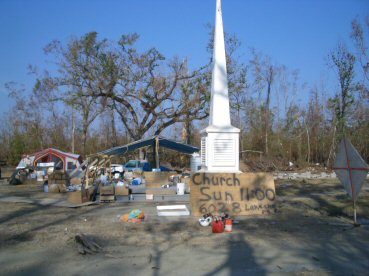




The steeple for Lakeshore Baptist Church was located several hundred feet back in the woods. The blue tarp served as a roof for the church for several weeks. On weekdays it became a relief center, and on Sunday a church building. Today a Quonset Hut, office suite, and bunkhouses along with a kitchen occupy the area as volunteers live there in order to rebuild the village of Lakeshore, Mississippi.


The remains of once majestic homes facing the Gulf of Mexico in Waveland, Mississippi. The ruins of these homes were washed several hundred yards inland.


The Immanuel Baptist Church Children's Building. Volunteers cleaned everything up. Insurance is allowing the three buildings which were destroyed to be combined for the construction of a multi-purpose building.


Gas lines stretched for more than a mile everytime a station would have the magic combination of gasoline and electricity.


Part of the tree damage to our house. We had water throughout and we lost three rooms and a bathroom with tree damage. We hope to be back in the house before the end of 2006.


© 2006 Mike Rasberry

Saturday, November 11, 2006

Government Education and The Pledge of Allegiance 11/11/2006

The students at Orange Coast Community College recently voted to drop the Pledge of Allegiance http://www.cnn.com/2006/EDUCATION/11/10/no.pledge.ap/index.html. One student argued that the pledge: (1) inspires nationalism. (2) violates the separation of Church and State. (3) is irrelevant to the business of student government.

A spokesperson for the district said the decision is up to the students, because they run their own show.

The event and the response to it demonstrate why so-called higher education is in large part to blame for the continuing failure of government elementary and secondary schools throughout the land.

First let me say that students are generally supported by tax dollars, and therefore should be subject to the taxpaying public, not the whims of immature student leaders. Students should learn responsibility and decision making, but it should be under the guidance of those tutors entrusted with the task. In other words, the taxpaying public should be able to set the parameter under which they are taught.

When I hear students bemoan the fact that “The Pledge” inspires nationalism, I groan in my spirit. We are Americans and we should be proud of that fact. I’ve traveled widely in the world, and other countries are much more nationalistic than America. We have been blessed to live in a land flowing with rich natural resources. Ours is a land which has stood for over two centuries as a beacon to the world that men can live free in a society where they can develop their talents to the degree they are willing to discipline and apply themselves. Ours is a land where one can travel the length and breath without having to stop regularly along the way to justify his movement. Ours is a land where a young man from a poor East Central Mississippi Community can travel the world and speak with leaders of states and countries as an equal. Ours is a land where one can choose the career he or she wishes to pursue. Ours is a land where a dramatic change of government can be accomplished without the firing of a single shot.

Yes, a thousand times yes, “The Pledge” inspires nationalism. I am now in the sixth decade of my life, yet I still have chill bumps when the National Anthem is played, or when someone sings “God Bless America”. We should teach nationalism. We should teach our children that being an American is a blessing that men and women the world over would die to have.

The second premise the young student argued was that “The Pledge” violates the separation of Church and State. Those who hold such views either ignorantly, or deliberately, ignore the fact that America was established on New Testament Christian principles. Godless, humanistic philosophers have somehow stolen away the Biblical heritage of our great country and relegated the dramatic intervention of Almighty God in the establishment of America to “good fortune”, “luck”, and “brilliant strategy”. No clause ever intended that America be a country separate from God. Founding father after founding father promoted the notion that we are a nation set aside by and under God. “The Pledge” is simply a latter day reflection of that which is posited in the daily record of the accounts of early legislative activity.

Yes, we are “under God”. Only the supreme egotist could imagine that we have risen to dominate the world as no nation in history because of our wisdom, goodness, and inherent strength. Our language has become the business language of the world. Our currency is accepted and coveted in the most remote regions. Our citizens are welcomed with open arms in the homes of citizens around the globe. Is because we of ourselves are so great? No. A thousand times No. For some reason Almighty God has chosen to raise us up at this time for His own unfathomable purposes. However, we need take care lest we like the Biblical Nebuchadnezzar be cast out into the wasteland as wild beasts.

The third premise espoused by the young student leader was that “The Pledge” is irrelevant to the business of governing. This premise also demonstrates the total lack of education of our young. Without a standard to guide us in the deliberations of life, we are will be blown thither and yon by whatever wind of public opinion is most pressing at the moment. For the business man it is a clearly defined business plan, the faithful and energetic execution of which he depends upon for his success. For the non-profit leader it is a succinct purpose statement so designed as to keep him focused on the ultimate goal. For those in government education, one purpose is the recognition that they have a fiduciary duty to promote allegiance to the government which represents the citizens who have made possible such education.

These students, should they be allowed to maintain their disastrous course, will set precedent the end of which is to lower the bar of responsibility throughout the government educational system even more than is already apparent. Somewhere, somehow, someone must step forward and exercise responsibility and authority to say enough is enough.

Friday, November 10, 2006

Right Thinking About Immigration

One unique thing about America is that God continues to send the world to us. Since our beginning, we have welcomed those from other countries who sought a new start, a new beginning, real hope. The words inscribed on the base of the Statue of Liberty there in New York Harbor reflect that philosophy. It reads: “ Not like the brazen giant of Greek fame with conquering limbs astride from land to land, here at our sea while sunset gates shall stand a mighty woman with a torch whose flame is the imprisoned lightning and her name is Mother of exiles. From her beaconed hand glows worldwide welcome, her mild eyes command the air bridged harbor that twin cities frame. Give me your tired, your poor, your huddled masses, yearning to breathe free, the wretched refuse of your teeming shores. Send these, the homeless, tempest tossed to me. I lift my lamp beside the golden door.”

Throughout the years we have welcomed to our shores those very people, and they have melted into a single entity called Americans. They learned the language, the customs, and the values of this land of opportunity. They built entire communities and contributed to the greatness of contemporary society.

Today a new breed has arrived on our shores. They don’t seem to want to become Americans, and seem intent on dividing the culture by refusing to learn the language and expecting society to accommodate them. They often seem more dedicated to perpetuating the cultural norms which have kept their countrymen in poverty for generations, than in becoming integrated into the real fabric of our country. This is not the true meaning of Lady Liberty’s inscription.

Official government policy appears designed to facilitate such attitudes. Bi-and in some cases tri-lingual government offices encourage these aliens to continue speaking their native tongue with little pressure to learn English. Teachers are recruited with the intent of making life easier for the children rather than for the purpose of teaching children to learn English.

Please do not misunderstand. Cross-cultural interaction is a sociological necessity if we are to maintain access to America by immigration. However, Cross-cultural does not mean facilitating those who refuse to do what is necessary to obtain a working knowledge of the language. America is an English speaking representative democracy. Cross-cultural means that we reach across cultural, social, linguistic, and ethnic barriers to assist immigrants as they become immersed in the American way of Life.

America is richer, more colorful, and more flavorful because the influx immigrants touch us and affect us. We need them, but we also need them to become Americans. We need them to learn about the heroes who lived sacrificial lives in order to make our present lifestyles possible. They need to learn the values which moved men to subjugate their thirst for power for the general good. They need to learn of the blood which was spilled through succeeding generations to bring about the current freedom. They need to learn about our holidays and the men and women who are represented in them.

This is not the time to return to the isolationism promoted by many prominent personages. Ours is a blessed country and should we close our borders, we might lose the moral high ground which has characterized our land. But we must emphatically declare that the privilege of living in America carries with it the responsibility to become Americanized.